League Play
Definition: League play refers to organized recurring disc golf competition conducted on a regular schedule—often weekly or seasonally—in which players participate in structured rounds for standings, ratings, prizes, handicaps, points, or community recognition. League play serves a role between casual recreational rounds and formal tournaments by combining competitive structure with social familiarity and local community. Leagues may range from highly competitive advanced divisions to beginner-friendly handicap formats designed to encourage broad participation. Because league players often compete repeatedly on the same courses against many of the same participants, league play develops its own rhythms, rivalries, traditions, scoring benchmarks, and social dynamics. For many disc golfers, league play is the primary environment in which to improve competitively, build friendships, learn local course strategy, and integrate into the broader disc golf community.
Why It Matters: League play provides accessible recurring competition where players develop consistency, emotional resilience, strategic decision-making, and tournament readiness under meaningful but manageable pressure. Leagues also strengthen local disc golf communities by creating regular social interaction, organized play opportunities, mentorship, and shared course stewardship among players of varying skill levels.
Term Observations:
- Many players use league play as a bridge between casual recreational rounds and larger sanctioned tournament competition.
- Handicap-based leagues are often designed to allow players of widely differing skill levels to compete meaningfully against one another.
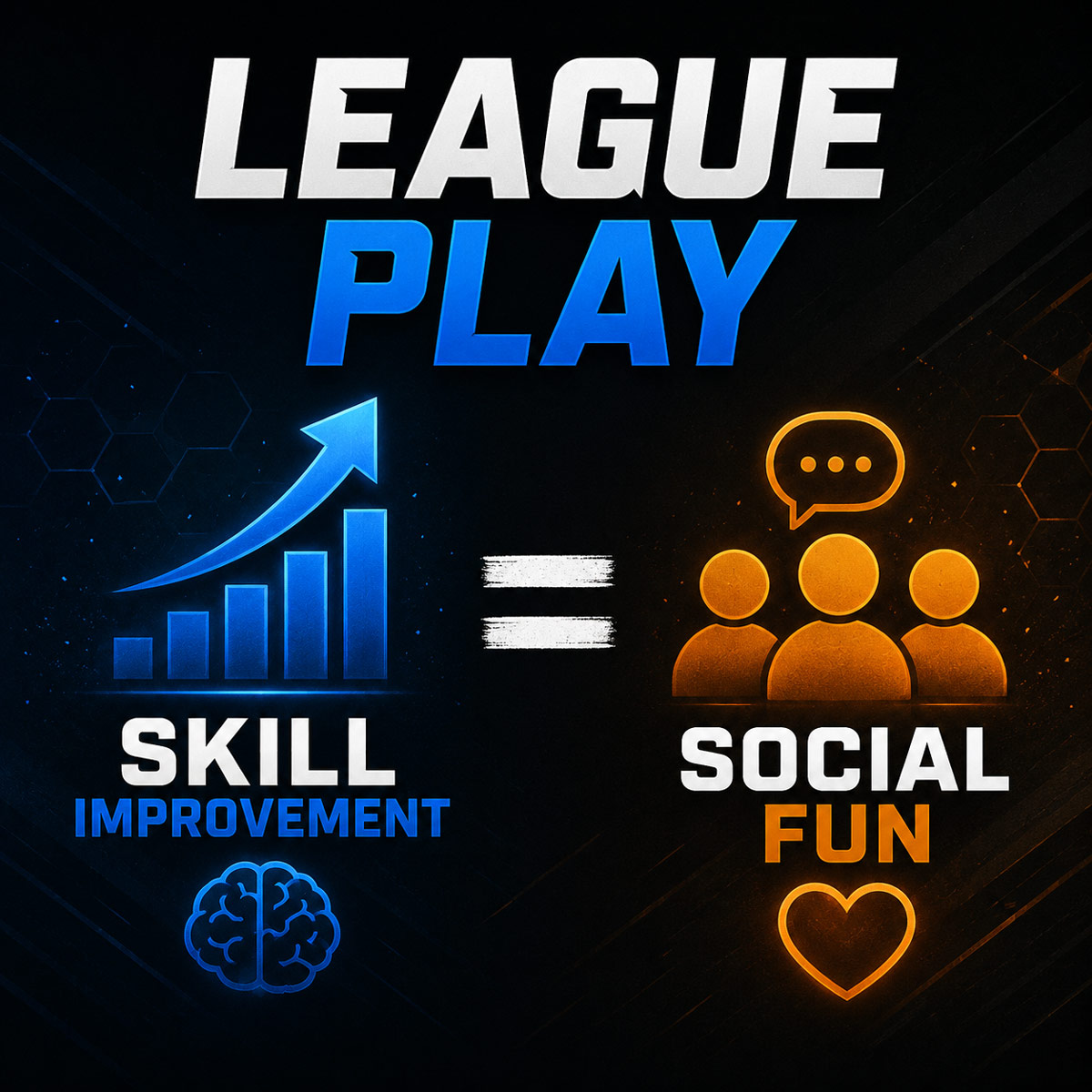
- Some leagues emphasize highly competitive scoring and ratings performance, while others prioritize social atmosphere, skill development, and community participation.
- Regular exposure to competitive pressure during league rounds helps players become more comfortable managing nerves during tournaments.
- League play may develop long-running rivalries, traditions, inside jokes, and local legends supporting a course’s community identity.
- Local knowledge gained through repeated league play promotes good strategic decision-making on the courses regularly used.
- Leagues may experiment with alternative formats such as doubles, glow rounds, skins matches, random draw partners, ace pools, or themed events to maintain variety and community engagement.
- League directors serve important organizational roles by coordinating scoring, payouts, scheduling, enforcing rules, and keeping communications flowing.
- Strong league communities often contribute to course maintenance, fundraising, advocacy, and the long-term growth of local disc golf infrastructure and exposure.
- League play serves as the social heartbeat of disc golf in many communities, combining competition, repetition, improvement, and interaction on a regular basis.
© 2026 North Georgia Canopy Tour Property, LLC d/b/a DiscLula. All rights reserved.