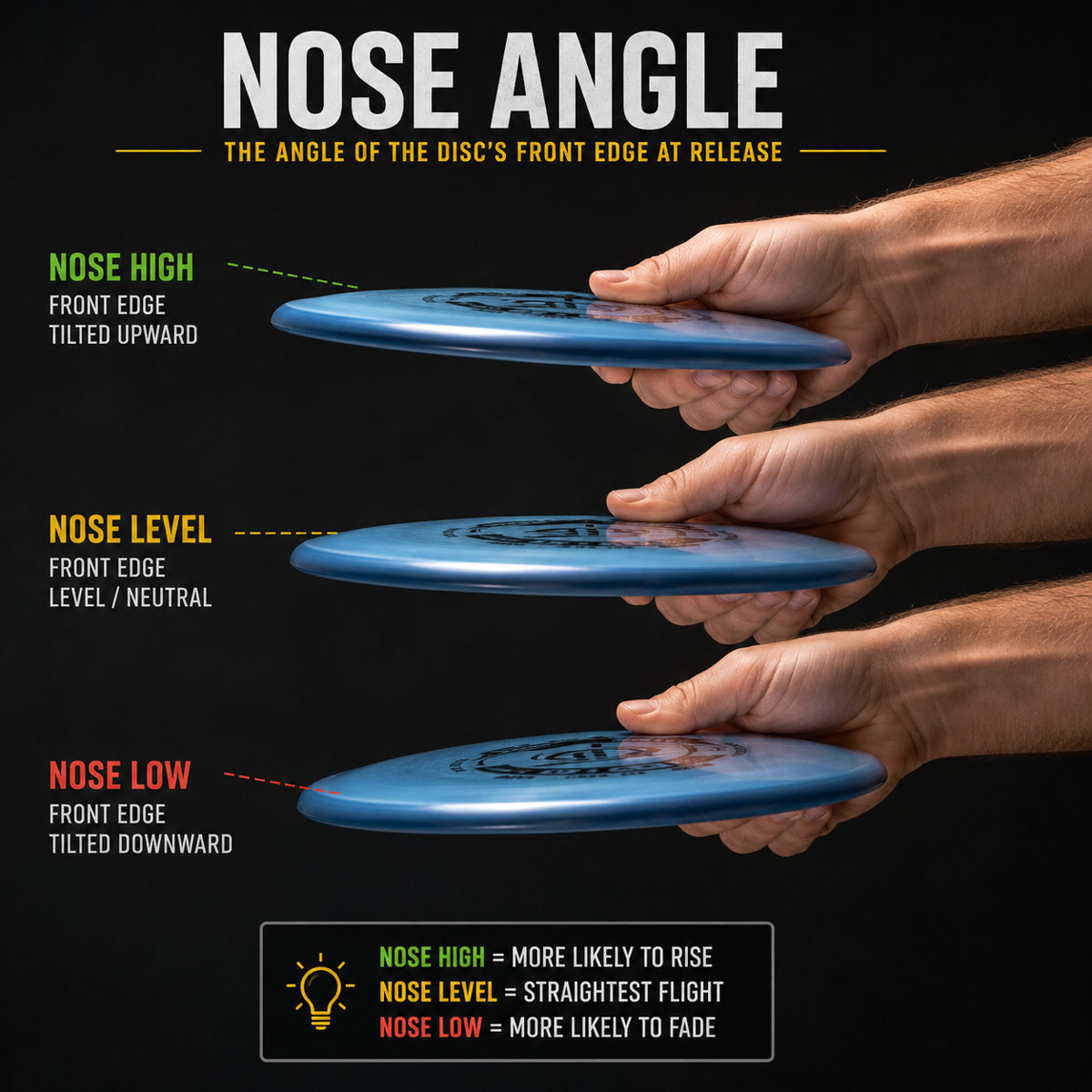
Nose Angle
Definition: Nose angle is the upward or downward orientation of the leading edge, or “nose,” of a disc relative to its direction of travel at release. A nose-down release positions the front edge slightly below the rear of the disc, while a nose-up release positions it above the rear. Nose angle differs from release angle in that release angle determines whether the disc is thrown flat, on hyzer, or on anhyzer, while nose angle influences how efficiently the disc moves forward through the air.
Why It Matters: Nose angle affects distance, speed, glide, height, and flight shape. A properly controlled nose-down release allows the disc to penetrate forward, maintain speed, and follow its intended flight path. A nose-up throw usually climbs, slows down, fades early, and loses distance. However, a deliberate nose-up release can be useful for short approaches, stalls, floaty putts, and shots designed to land softly. Consistent nose-angle control produces more accurate, efficient, and repeatable throws.
Term Observations:
- Nose angle is important across the board in backhand throws, forehand throws, distance drives, approach shots, and putting.
- A disc may be released on the correct hyzer or anhyzer angle but still fly poorly because its nose angle is incorrect.
- Players often throw nose-up when they lean backward, raise the front of the disc, or pull the disc upward during the release.
- Faster discs require more precise nose-angle control than slower discs.
- Wind can magnify nose-angle errors, especially when the underside of the disc is exposed.
- Nose-angle control coordinates grip, wrist position, reach-back, swing plane, release point, and follow through to produce the intended flight.
© 2026 North Georgia Canopy Tour Property, LLC d/b/a DiscLula. All rights reserved.