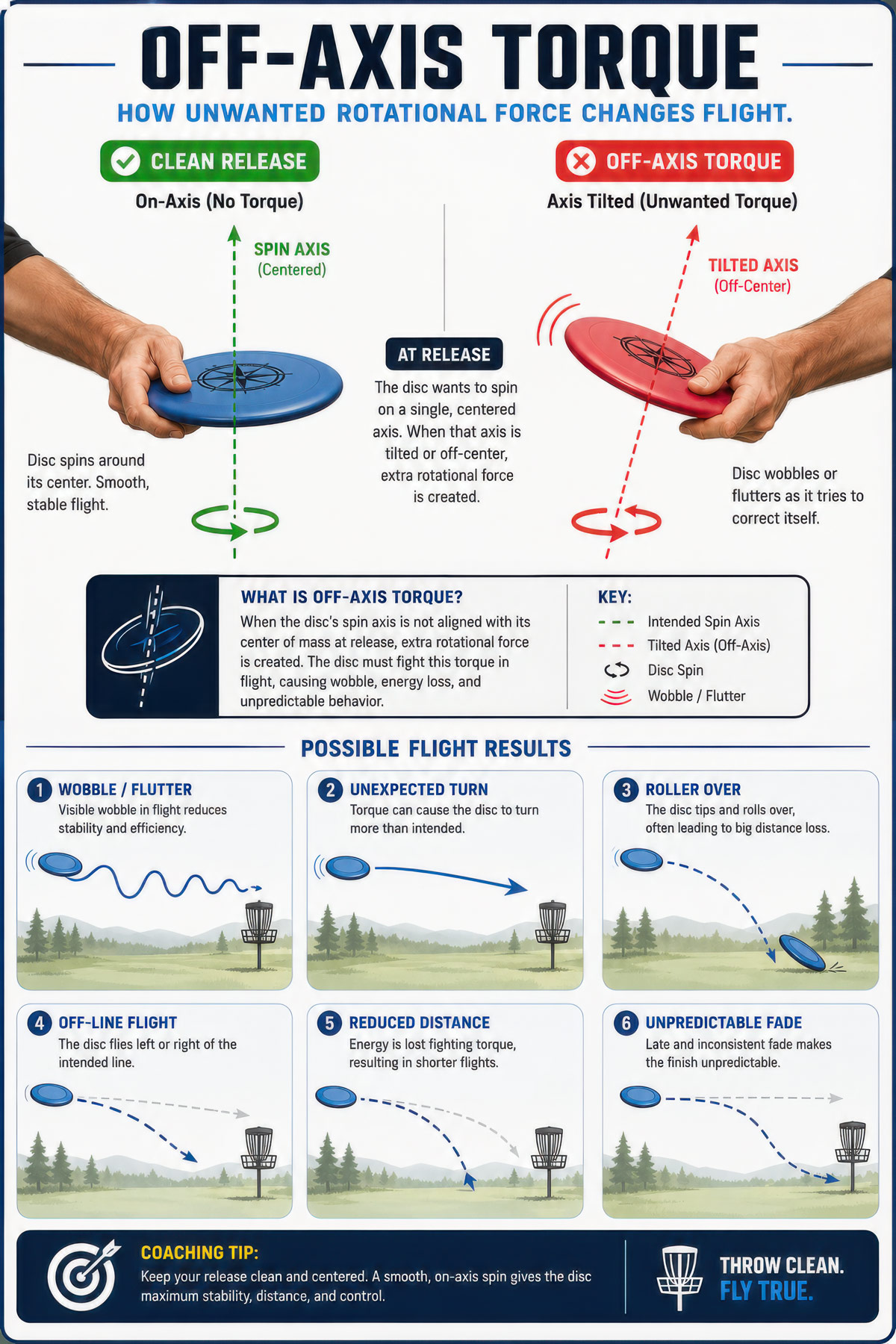
Off-Axis Torque
Definition: Off-axis torque, commonly abbreviated as OAT, is rotational force applied to a disc in a direction that does not align with its intended axis of spin. It usually occurs when the hand, wrist, arm, or body moves out of the throwing plane during the release. Instead of leaving the hand with clean, centered rotation, the disc wobbles, flutters, or tilts as competing forces act upon it. Off-axis torque is most often an unintended mechanical flaw, although experienced players may occasionally manipulate it to create unusual flight shapes.
Why It Matters: Off-axis torque affects stability, accuracy, speed, distance, and flight consistency. A disc released with excessive OAT may turn more than expected, drift off line, roll over, fade unpredictably, or lose energy through wobble. These problems are often blamed on the disc when they are actually caused by the throw. Reducing off-axis torque allows the disc to spin more cleanly, hold its intended release angle, and produce a smoother and more repeatable flight.
Term Observations:
- Off-axis torque can occur in backhand throws, forehand throws, approach shots, and putting.
- Clean grip pressure, balanced mechanics, controlled acceleration, and a smooth release help reduce off-axis torque.
- Common causes include wrist roll, uneven acceleration, rounding, pulling off the intended swing plane, and an abrupt follow through.
- Visible wobble immediately after release is a sign of off-axis torque, although not every form of OAT is easy to see.
- Putters and neutral midrange discs often reveal off-axis torque more clearly than fast or overstable drivers.
- Players may mistake an OAT-induced turnover for evidence that a disc is too understable.
© 2026 North Georgia Canopy Tour Property, LLC d/b/a DiscLula. All rights reserved.