Sidearm
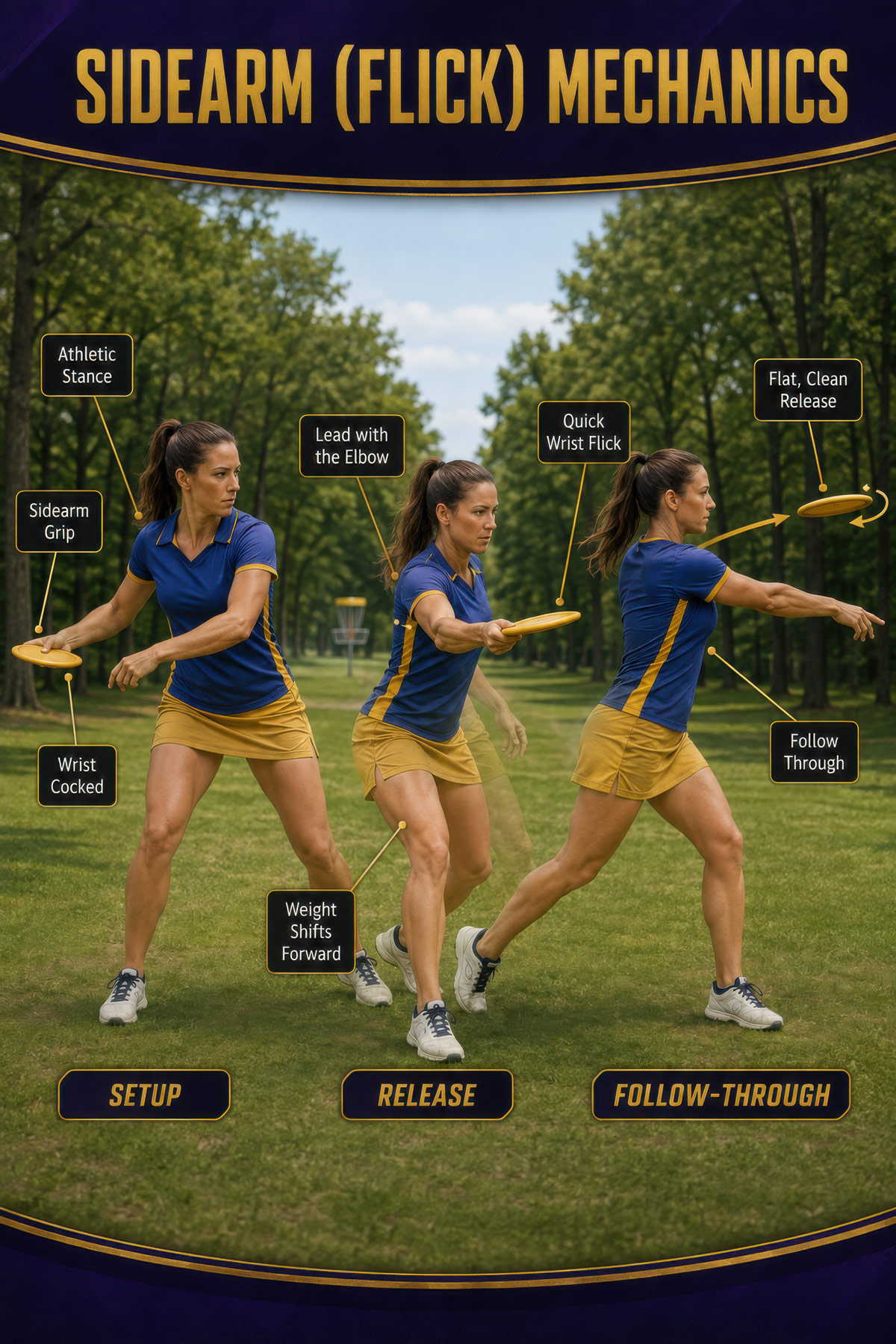
Definition: Sidearm is another name for a forehand throw in which the player holds the disc beside the body and propels it forward with an outward arm motion and a quick wrist-driven release. For a right-handed player, a sidearm throw usually spins clockwise and naturally fades to the right; for a left-handed player, it usually fades to the left. Sidearm throws can be used for drives, approach shots, recovery shots, and controlled placement shots.
Why It Matters: The sidearm gives players a flight direction that complements the backhand without requiring them to throw with their nondominant hand. It is especially useful when obstacles, doglegs, restricted lies, or landing zones favor a disc that finishes toward the throwing-hand side. A controlled sidearm can produce accurate low-ceiling shots, skip shots, flex lines, and approaches. Poor sidearm mechanics, however, may cause wobble, unintended turnover, excessive torque, inconsistent release angles, and strain on the elbow or shoulder.
Term Observations:
- Sidearm and forehand generally refer to the same throwing technique.
- Sidearm throws rely on coordinated footwork, elbow position, wrist action, spin, and follow through rather than arm strength alone.
- Overstable discs are commonly used for sidearms because they resist turning and provide a dependable finish.
- Sidearm shots can be released on hyzer, flat, or anhyzer angles to create different flight paths.
- A compact sidearm is particularly useful for approach shots, wooded fairways, and obstructed lies.
- Smooth acceleration and clean spin help reduce wobble and improve distance and accuracy.
© 2026 North Georgia Canopy Tour Property, LLC d/b/a DiscLula. All rights reserved.