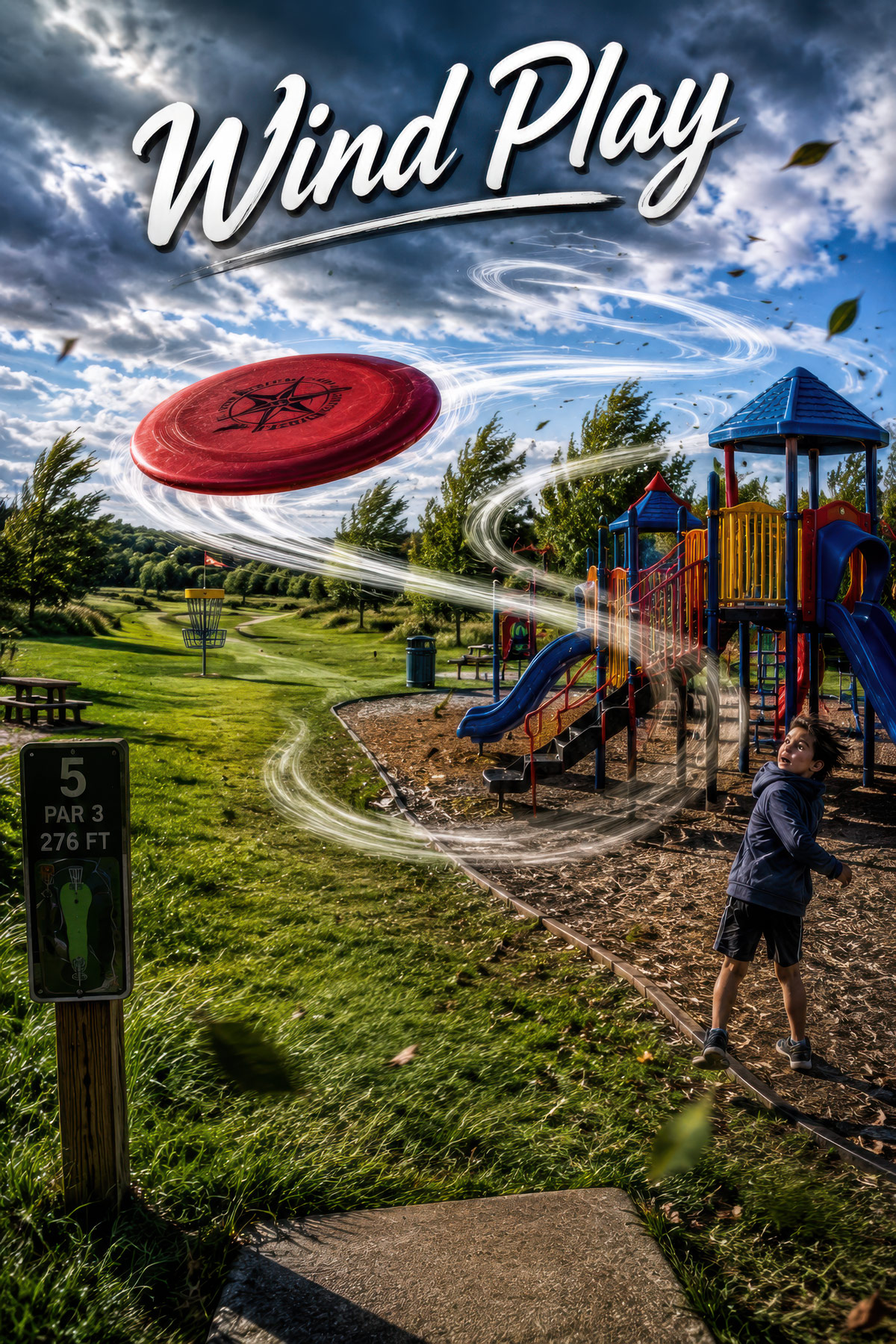
Wind Play
Definition: Wind play refers to the strategic and technical adaptation of disc golf throws, disc selection, angles, and shot execution to account for wind conditions. Wind play is one of the sport’s highest skill separators because of wind’s impact on disc stability, glide, turn, fade, distance, and landing behavior. Unlike static obstacles such as trees or terrain, wind introduces a constantly shifting aerodynamic variable that players must interpret and manage. Effective wind play requires understanding not only general wind direction and strength, but also how different discs and release angles interact with headwinds, tailwinds, crosswinds, elevation changes, and localized air movement near obstacles or terrain features. Skilled players manipulate stability, height, spin, and trajectory in order to use the wind strategically rather than merely survive it. Wind can magnify both great execution and small mistakes, making it a defining element when present.
Why It Matters: Wind can completely transform how discs behave in flight, making intelligent adaptation essential for scoring consistency and control. Players with strong wind-play skills are often able to maintain composure, minimize mistakes, and preserve predictable flight behavior under difficult conditions while competitors struggle with exaggerated turn, stalls, fades, skips, or loss of distance control. Superior wind play can drive major scoring separation.
Term Observations:
- Headwinds generally make discs behave more understable by increasing effective airspeed and exposing discs more aggressively to high-speed turn.
- Tailwinds often suppress glide and make discs behave more overstable by reducing lift and forward carry.
- Crosswinds can dramatically alter flight shape and landing behavior depending on disc angle, stability, spin, and orientation relative to the wind direction.
- Experienced players may turn to overstable discs during windy rounds because they provide increased predictability and resistance to unwanted turning movement.
- Lower trajectories are commonly preferred in strong winds because height usually increases exposure to unpredictable lift and drift.
- Wind near the ground may behave very differently from wind higher in the air, making elevation and release height important strategic considerations.
- Low-speed putting in heavy wind is psychologically challenging because small aerodynamic changes can dramatically alter low-speed flight behavior.
- Courses can become fundamentally different competitive experiences under strong wind conditions, as normally attackable holes may transform into conservative survival challenges.
- Elite players frequently manipulate release angle, nose angle, spin rate, and disc stability specifically to exploit or neutralize wind effects during flight.
© 2026 North Georgia Canopy Tour Property, LLC d/b/a DiscLula. All rights reserved.